
Polish Chemistry Congress Recap
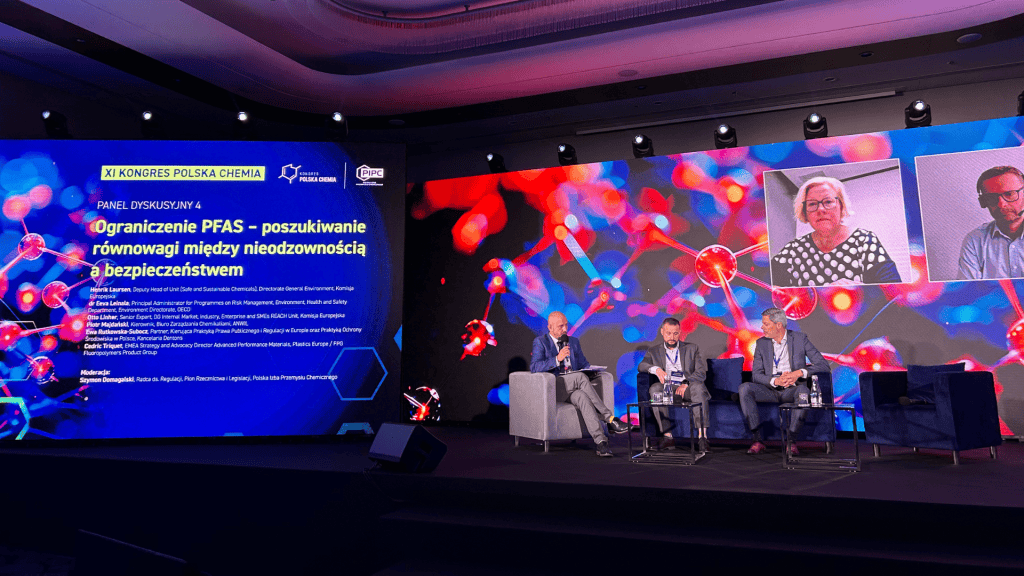
Polish Chemistry Congress – PFAS panel, 2024.06.06, Warsaw
Moderated:
- Szymon Domagalski, Regulatory Counselor, Advocacy and Legislation Division, Polish Chamber of Chemical Industry.
Panelists:
- Otto Linher, Senior Expert, DG Internal Market, Industry, Enterprise and SMEs, REACH Unit, European Commission
- Dr. Eeva Leinala, Principal Coordinator, Environment, Health and Safety Division, OECD
- Henrik Laursen, Deputy Head of Unit, DG Environment, European Commission
- Cedric Triquet, Strategy and Advocacy Director, Chemours Advanced Performance Materials Division on behalf of Plastics Europe / FPG Fluoropolymers Product Group Management Committee
- Piotr Majdański, Head of the Chemical Management Office, Anwil
Summary of the Points:
Dr. Eeva Leinala – OECD
- OECD has been working on PFAS for the past 25 years (PFOA, PFOS, etc)
- In 2012, a global PFAS group was established towards better management and communication around these chemicals (SAICM resolution)
- OECD prepares reports on the development of alternatives and risk management approaches.
- There are different approaches to risk management: globally the Stockholm Convention regulates some PFAS substances, but Canada, Japan, the EU and the USA all have different approaches.
Otto Linher – DG GROW
- EU also started regulating PFAS substances, first restricting one substance, PFOS, then the industry moved to another PFAS substance – innovation has always been faster than regulation.
- Regarding the ongoing U-PFAS restriction process, there will not be a full ban and derogations will be granted where no alternatives are available.
- The European Commission does not intervene in the scientific process in ECHA.
- The proposed restriction will have a large impact, which is also seen by the more than 5600 responses submitted to the public consultation.
- The proposal has already impacted some companies’ investment decisions; therefore, the EC needs to give a signal to the market.
- In the case of Teflon pans, alternatives are available, so there will be a ban.
- For other uses, it is much more complex to assess the alternatives.
- The EC has leeway to decide what is not going to be restricted, once the ECHA committees have submitted their assessment to the EC.
- Regarding the timeline, the EC does not expect to have a restriction before 2027.
- In terms of enforcement, he acknowledged it is not easy to control the chemicals in products, but he was certain enforcement projects would be put in place.
- In parallel, the EC is also working on other concepts, such as essential use and substitution planning.
Henrik Laursen – DG ENV
- The EC recently published a communication on the essential use concept that has already been referred to in the Montreal Protocol.
- The communication sets out principal considerations, but will only be legally binding once it is introduced into law, i.e. during the REACH review.
- In order for a use to be considered essential, it needs to meet two criteria:
- Be necessary for the health, safety, or critical functioning of society.
- No acceptable alternatives are available.
- The EC would not like to have SVHC in consumer products.
- He acknowledged that PFAS substances fulfil important functions in industrial settings, especially in the green transition, semiconductors, and energy products play an important role in lowering GHG emissions.
Cedric Triquet – FPG
- Cedric explained the difference between fluoropolymers and other PFAS substances.
- Fluoropolymers do not pose a significant risk to health and the environment.
- The persistence of fluoropolymers gives them durability, which is essential in industrial settings, from heavy-duty to high-tech industries.
- The emissions can be controlled during production, FPG members, fluoropolymer producers, have made a commitment to significantly reduce emissions from manufacturing by the end of 2024 and then, as the next step, by 2030.
- FPG does not oppose regulation but supports a coherent science-based regulatory approach to industry.
Piotr Majdański – Anwil
- As a fertilizer company, they do not use PFAS substances in their products but rely on them in their manufacturing processes.
- The restriction proposal has created a lot of uncertainty in the market.
- The one substance – one assessment approach has changed to thousands of substances – one assessment approach.
- Whereas in the case of a restriction of one substance, it was easy to identify where it is used, however, with such a broad definition, companies are still in the process of identifying all the uses of all the PFAS substances.
- He questioned who would take the decision and the responsibility of restricting a certain substance which could result in major accidents in chemical plants.
- In the current geopolitical situation and the energy crisis, perhaps it is not the most appropriate time to start a revolution in the chemical industry – we need evolution, not revolution.
- Anwil so far has identified F-gases and foam blowing agents as critical PFAS substances for their operations – alternatives like ammonia and propane are explosive and toxic for workers, in addition, F-gases are used in closed systems – there is no advantage to replacing them simply because alternatives exist.