
High-performance materials for essential applications
Fluoropolymers are advanced materials designed to perform reliably in some of the most demanding environments. Their exceptional durability, chemical resistance and stability make them important for critical applications across healthcare, renewable energy, transport, electronics, defence and advanced manufacturing.
Because they are long-lasting and resistant to degradation, fluoropolymers help products and systems operate safely and efficiently over time. Their performance can support longer service lifetimes, reduced maintenance and lower material waste.
During their intended use phase, fluoropolymers are chemically inert, non-bioavailable and environmentally stable. These characteristics distinguish them from certain other PFAS substances and are among the reasons experts have described fluoropolymers as displaying properties predictive of low hazard.
Scientific assessments consider factors such as molecular weight, solubility, stability, bioavailability and potential for environmental or health impact. Based on these criteria, fluoropolymers should be considered separately from smaller, mobile or bioavailable PFAS substances.
What makes fluoropolymers unique?
Fluoropolymers combine several high-performance properties in one material. Their strong carbon-fluorine bonds help them withstand heat, chemicals, weathering and demanding operating conditions while maintaining reliable performance over long service lifetimes.
Key properties at a glance
Chemical resistance
Protects equipment and processes exposed to solvents, acids, bases and aggressive substances.
Thermal stability
Performs reliably across a wide temperature range, including very hot and very cold conditions.
Low friction and non-stick performance
Reduces sticking, build-up and wear in coatings, moving parts and specialist equipment.
Electrical insulation
Helps protect wires, cables and electronic components in high-performance systems.
Weather and UV resistance
Resists ageing, sunlight and outdoor exposure, helping materials last longer.
Biocompatibility
Supports selected medical and healthcare applications where material purity and compatibility are essential.
How are fluoropolymers different from other PFAS?
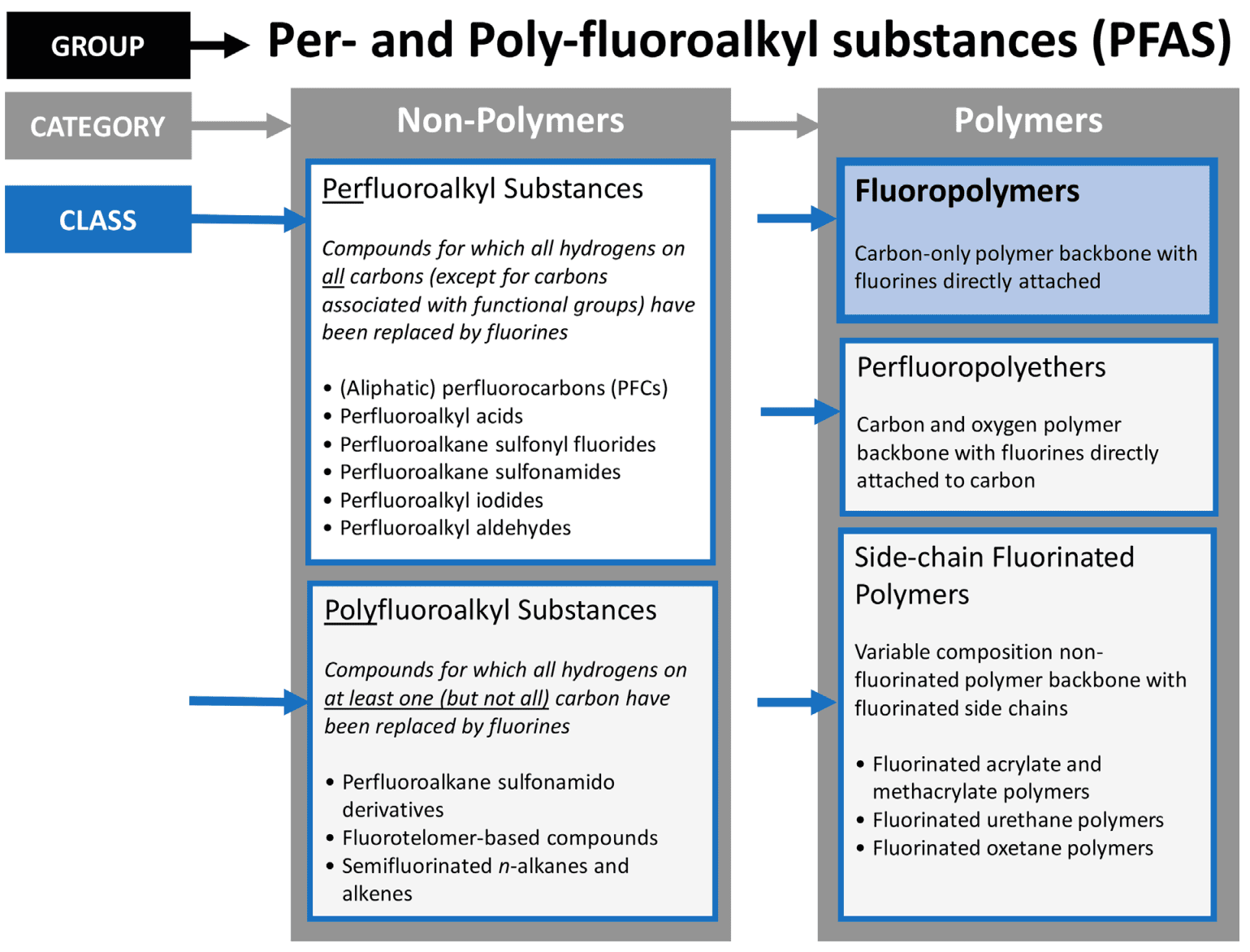
Fluoropolymers fall within broad definitions of PFAS because of their chemical structure. However, PFAS is a very large and diverse family of thousands ofsubstances with widely different properties, behaviours and uses.
This distinction matters. Certain PFAS, such as PFOA and PFOS, have been identified as substances of toxicological or environmental concern. Fluoropolymers, by contrast, are high molecular weight polymer materials with different physical, chemical and toxicological characteristics.
Fluoropolymers are large, stable materials and are not considered toxic, bioaccumulative or mobile in the way that some small-molecule PFAS of concern can be. They should therefore be assessed on their own properties, uses and lifecycle.
Main types of fluoropolymers
Commercially available fluoropolymers are commonly grouped into two main families: fluoroplastics and fluoroelastomers. Both deliver high performance, but they are designed for different application needs.
01
Fluoroplastics are rigid or semi-rigid materials used where strength, durability, purity and resistance to heat or chemicals are required. Typical applications include films, membranes, linings, coatings, tubing, cable insulation and precision components.
02
Fluoroelastomers are flexible, rubber-like materials used where elasticity must be combined with long-term resistance to heat, fuels, oils and aggressive chemicals. They are often used in seals, gaskets, hoses and other components exposed to demanding operating conditions.
A differentiated approach
Fluoropolymers play an important role in applications where performance, safety and reliability are essential. A differentiated, science-based approach is needed to reflect how these materials behave in practice and to support their continued use in critical sectors where suitable alternatives may not be available.